Buy links on this page go through our /go/ redirects to the manufacturer or retailer. We earn nothing from them today; that may change. Disclosure.
In short
Read the number stamped on a drive link of your old chain, then count the drive links. The number gives you the pitch and gauge, and the count gives you the length. If you can't read the stamp, the bar and a ruler can fill in the gaps.
Once you have your numbers:
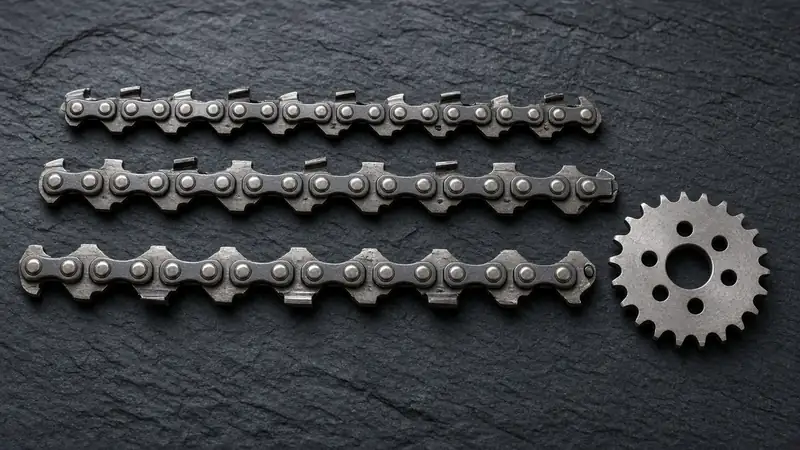
Oregon S56 (3/8 LP, .050, 56)Oregon S62 (3/8 LP, .050, 62)Oregon S52 (3/8 LP, .050, 52)Safety first: turn the saw off (or take the battery out) and wear gloves. Saw chain is sharp even when it's dull for cutting wood.
Step 1: read the code on a drive link
Drive links are the teeth on the inside of the chain that ride in the bar groove. Wipe one clean and look for a small stamped number.
- Oregon chain: the number is a code for pitch and gauge. For example, 91 means 3/8 in. Low Profile and .050 in. gauge, and 72 means 3/8 in. and .050 in. The full chart is on the chainsaw chain size chart.
- STIHL chain: STIHL stamps the last digit of the gauge in millimeters on every drive link (1, 3, 5 or 6), and the pitch on each depth gauge.
Oregon recommends ordering by this stamp because gauge is hard to measure accurately on a worn chain.
Step 2: check the tail of the bar
Take off the side cover and look at the back end of the bar, where it mounts to the saw. STIHL says every STIHL bar has the number of drive links it needs stamped there. Many other bars carry size markings there too, so look before you start counting.
Step 3: count the drive links
- Lay the chain out or leave it on the bar.
- Mark one drive link with a paint pen or a bit of tape.
- Count every drive link all the way around until you reach the mark again.
That count is the chain's length. A chain with even one link too many or too few won't tension correctly.
Step 4: measure pitch if nothing is readable
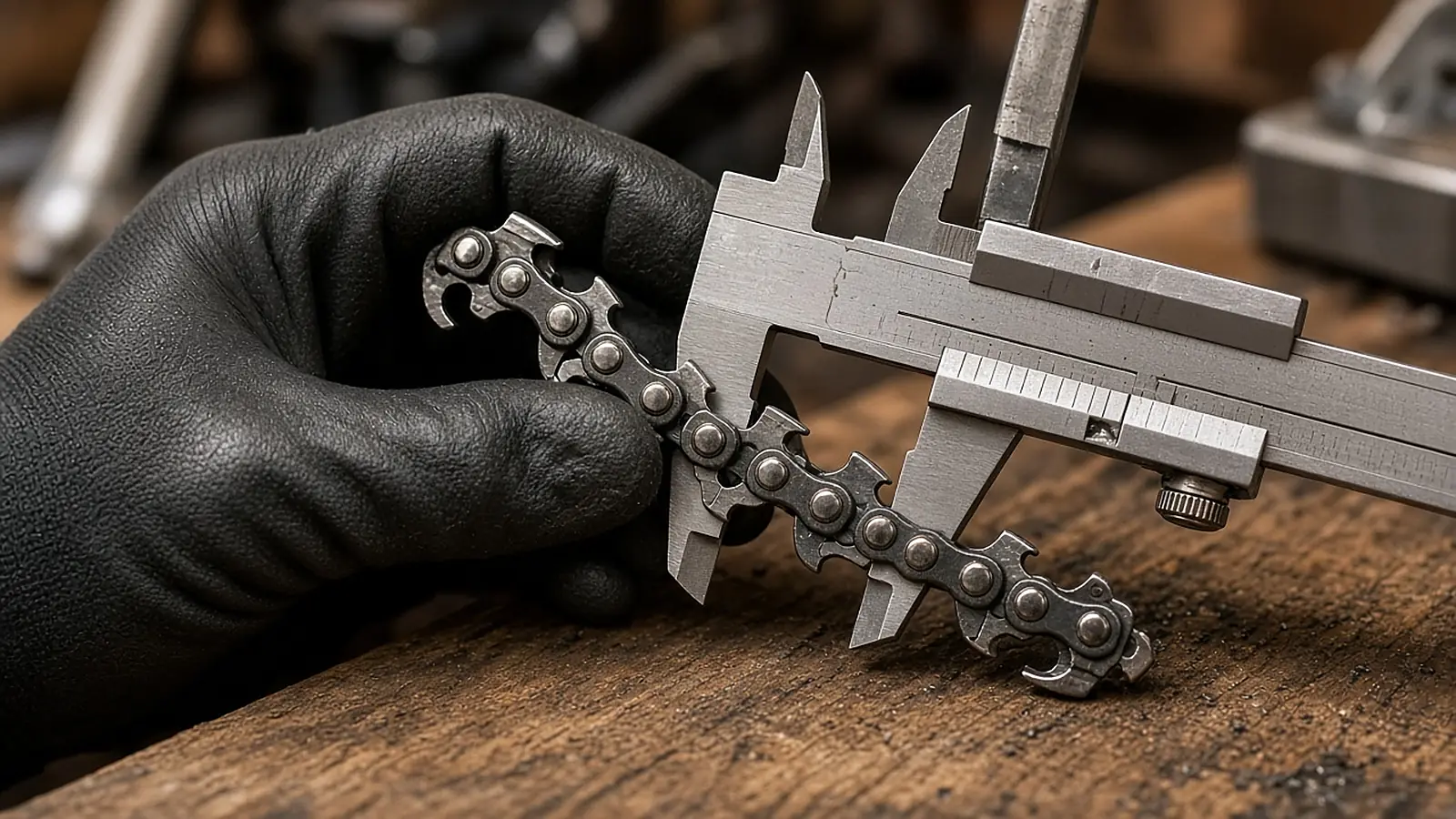
Measure from the center of one rivet to the center of the third rivet in a row, then divide by two. Oregon and STIHL both give this method. Common results:
| Three-rivet distance | Pitch |
|---|---|
| About 1/2 in. | 1/4 in. |
| About 0.65 in. | .325 in. |
| About 3/4 in. | 3/8 in. or 3/8 in. Low Profile |
| About 0.81 in. | .404 in. |
A ruler can't tell 3/8 in. from 3/8 in. Low Profile, because both have the same pitch measurement. In that case, the drive link code or the saw's manual is the way to tell them apart.
Bar length is the last thing to check
Chains are sold as "16 in." or "18 in.", but that's a rough guide. Match pitch, gauge and drive link count first. If they match your old chain, the new one fits, whatever the box says about inches.
Related
If a chain that seemed to fit keeps falling off, see chainsaw chain keeps coming off. For what pitch and gauge actually mean, see pitch vs gauge.
Questions people ask
Where is the chainsaw chain size stamped?
Oregon stamps a code number on the drive links that gives pitch and gauge. STIHL stamps the pitch on each depth gauge and the last digit of the gauge in millimeters on the drive links. STIHL also stamps the needed drive link count on the tail of the bar.
How do I measure chainsaw chain pitch?
Measure from the center of one rivet to the center of the third rivet in a row, then divide by two. Oregon and STIHL both give this method.
How do I count drive links?
Mark one drive link with a paint pen or tape, then count every drive link (the teeth that ride in the bar groove) until you get back to the mark.
Can I measure gauge on an old chain?
You can try, but Oregon says gauge is hard to measure on a worn chain. It recommends ordering by the number stamped on the drive link instead.
Sources
Last checked Oct 25, 2026. Sizes, stamp codes and tension steps come from Oregon, STIHL and Husqvarna guides and product pages. Turn the saw off (or remove the battery) and wear gloves before you touch the chain.