Buy links on this page go through our /go/ redirects to the manufacturer or retailer. We earn nothing from them today; that may change. Disclosure.
In short
Pitch is how big the chain is along its length. Gauge is how thick its drive links are. Pitch has to match the saw's drive sprocket, and gauge has to match the groove in the bar. A new chain needs both to match, plus the right drive link count.
Pitch
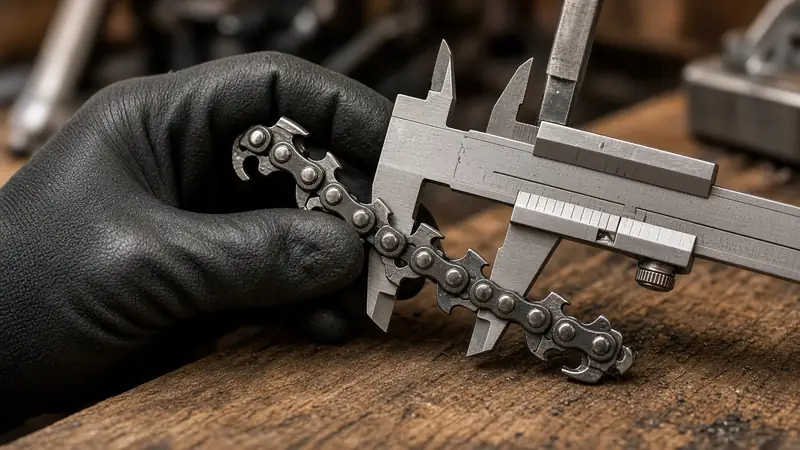
Oregon and STIHL both define pitch the same way: measure the distance between any three rivets in a row and divide by two. Oregon says pitch matters because the drive sprocket, and the bar's nose sprocket if it has one, must be the same pitch as the chain.
Oregon's chart lists these pitches, smallest to largest among common saw chains:
- 1/4 in. Oregon's smallest.
- 3/8 in. Low Profile. Husqvarna sells its version as "3/8 in. mini".
- .325 in.
- 3/8 in. Oregon's most popular pitch.
- .404 in.
Oregon also lists 3/4 in. as its largest, for large equipment.
Gauge
Gauge is the thickness of the drive link where it sits in the bar groove. Oregon sells .043, .050, .058 and .063 in. STIHL lists the same sizes in millimeters (1.1, 1.3, 1.5 and 1.6 mm), plus .080 in. for harvester chain only. Both say the chain's gauge must match the bar.
Gauge is harder to check by hand. Oregon says it's difficult to measure accurately on a worn chain and recommends ordering by the number stamped on the drive link instead.
Side by side
| Pitch | Gauge | |
|---|---|---|
| What it measures | Spacing along the chain | Drive link thickness |
| How to check | Three rivets, center to center, divided by two | Read the drive link code (hard to measure on worn chain) |
| Must match | Drive sprocket and nose sprocket | Bar groove |
| Where it's marked | Oregon: drive link code. STIHL: each depth gauge | Oregon: drive link code. STIHL: last mm digit on drive links |
Low Profile vs full 3/8
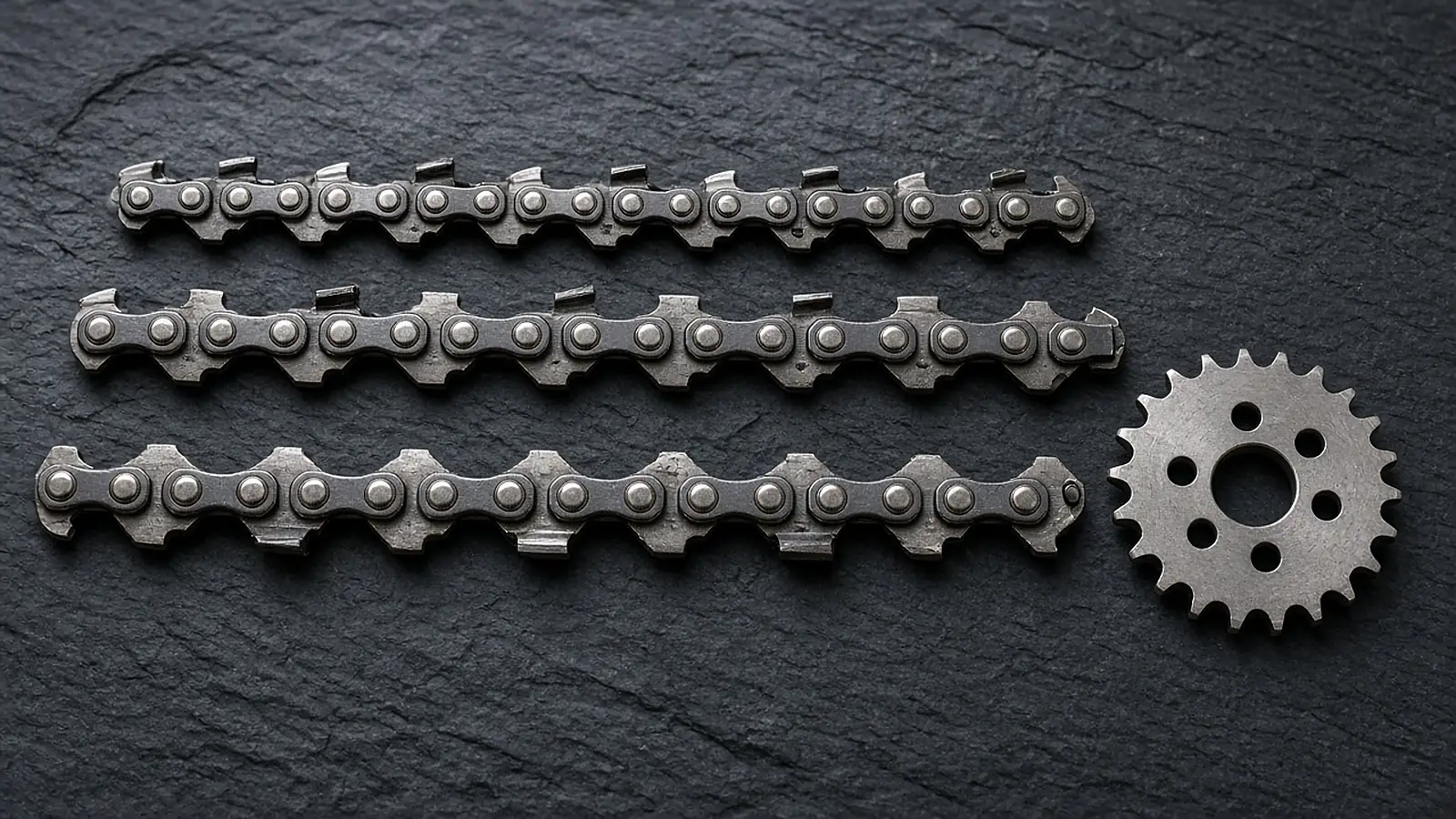
Both measure 3/8 in. across three rivets, but Oregon lists them as separate chains with separate codes: 3/8 in. Low Profile is 90 or 91, and full 3/8 in. is 72, 73 or 75. If your old chain says 91, buy a 91. The size chart has every Oregon code.
Why a mismatch matters
STIHL's guide lists a sprocket that doesn't match the chain's pitch as one cause of battered drive links, and Husqvarna lists the wrong pitch, gauge or drive link count as a main reason chains come off. If yours keeps jumping the bar, see chainsaw chain keeps coming off.
Don't forget the length: pitch and gauge get the chain to fit the bar and sprocket, but you still need the right drive link count. See how to tell what size chain you need.
Questions people ask
What is the difference between pitch and gauge?
Pitch is the chain's size along its length: the distance between three rivets divided by two. Gauge is the thickness of the drive links that ride in the bar groove. Pitch has to match the sprocket; gauge has to match the bar.
What is the most common chainsaw chain pitch?
Oregon says 3/8 in. is its most popular pitch. It lists 1/4 in. as its smallest and 3/4 in. as its largest.
What gauges do chainsaw chains come in?
Oregon sells .043, .050, .058 and .063 in. STIHL lists the same four (1.1, 1.3, 1.5 and 1.6 mm), plus .080 in. for harvester chain only.
Is 3/8 Low Profile the same as 3/8?
No. Oregon lists 3/8 in. Low Profile (codes 90 and 91) separately from full 3/8 in. (codes 72, 73 and 75). They are not swapped for each other, so match the code on your old chain.
Sources
Last checked Oct 25, 2026. Sizes, stamp codes and tension steps come from Oregon, STIHL and Husqvarna guides and product pages. Turn the saw off (or remove the battery) and wear gloves before you touch the chain.